 SJHYPS
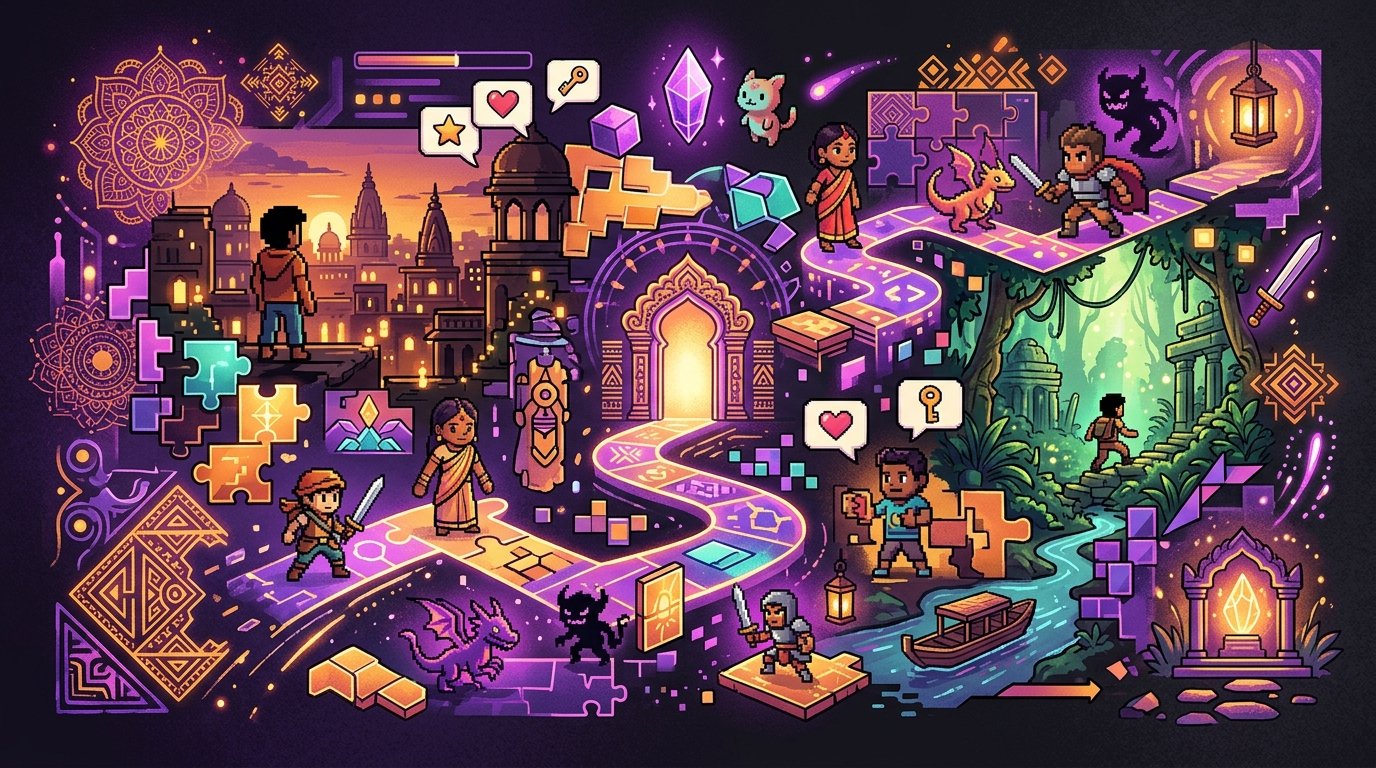
The Gap Between Perception and Reality
If you search for "Indian games" on any major storefront, you will find pages dominated by cricket simulators, card games, and free-to-play shooters optimised for low-end Android devices. That is not a criticism — those games serve a massive audience and the studios behind them are commercially successful. But they create a perception problem.
When people outside India think about game development in the country, they picture large outsourcing studios handling asset production for Western AAA titles, or mobile game factories churning out reskins. Both of those things exist and employ thousands of people. Neither of them tells you anything about the creative indie scene that has been quietly growing since around 2017.
The visible Indian game market versus what exists underneath — two very different pictures.
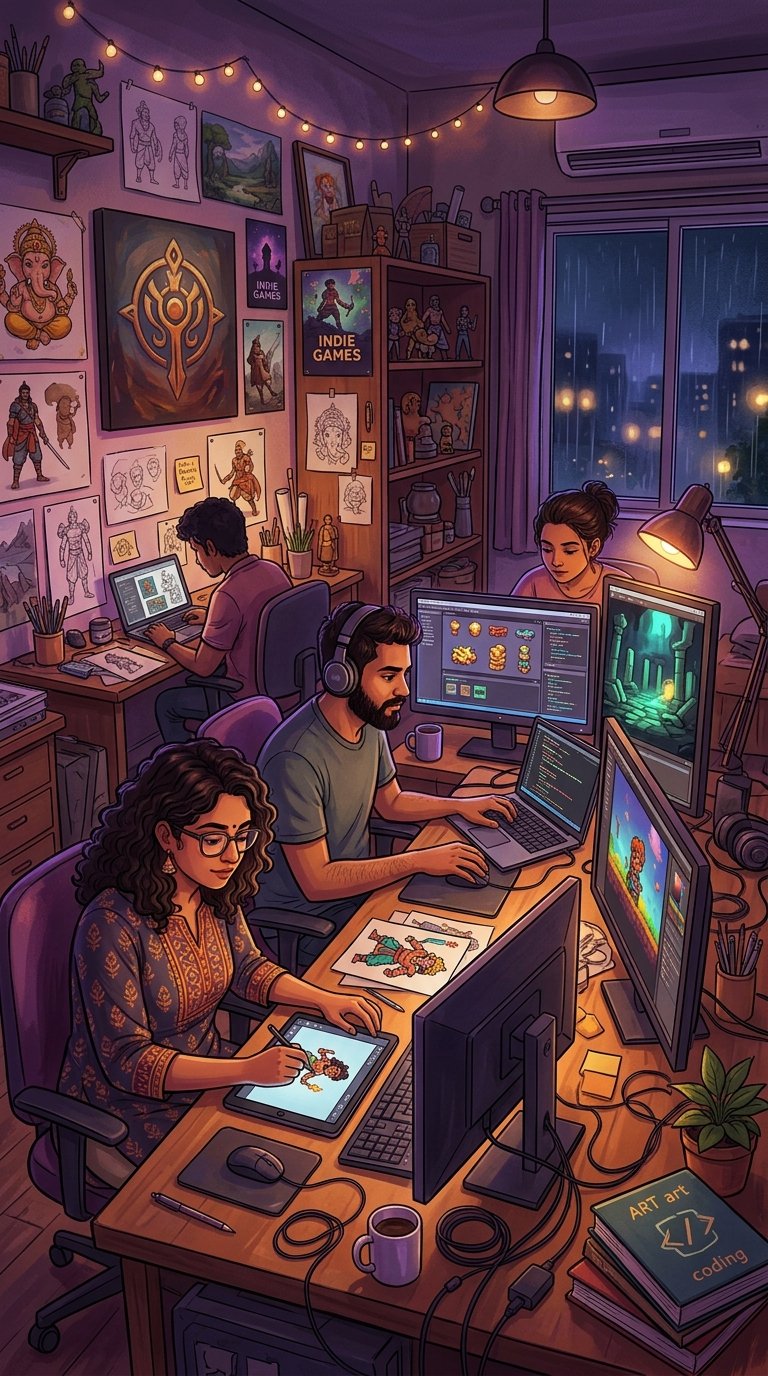
I have spent the last three years tracking indie projects from small teams across India. The number of genuinely original games being built by teams of one to twelve people is higher than most industry observers realise. These are not prototypes that go nowhere, either. Several have launched on Steam, some have been featured at international festivals, and a few have found audiences that surprised even their own creators.
What Makes the Indian Indie Scene Different
Every region has its own flavour of indie development. In Scandinavia, there is a strong tradition of minimalist puzzle games. Japan's doujin scene thrives on niche genre experiments. The Indian indie scene has its own distinguishing characteristics, and they are worth understanding before writing it off as derivative.
Cultural specificity in game design
Several Indian indie developers are drawing from local mythology, folk traditions, and regional history in ways that feel organic rather than performative. I have played a narrative game set during the partition of 1947 that handled its subject matter with more nuance than most history textbooks. Another project used Konkani folk tales as the basis for a point-and-click adventure with hand-painted art. These are not games trying to imitate Western or Japanese design philosophies — they are finding their own voice.
The specificity matters. When a game is rooted in a particular place and culture, it tends to feel more genuine than a product designed to appeal to a generic global audience. Players notice this. The indie games that break through internationally are almost always the ones that feel unmistakably from somewhere.
Resourcefulness under constraint
Most Indian indie developers are working with extremely limited budgets. There is no equivalent to the grant funding available in Canada or the Nordic countries. Publishers rarely take chances on unproven Indian studios. This forces a kind of creative problem-solving that shows up in the work. Developers become adept at using procedural generation, stylised art that doesn't require large teams, and narrative-driven gameplay that compensates for limited technical scope.
| Constraint | Common Adaptation | Example Genre |
|---|---|---|
| Limited art budget | Stylised or minimalist visuals | Narrative, puzzle |
| Small team (1–3 people) | Scope-limited design | Short-form adventure |
| No publisher funding | Self-funded prototypes | Experimental, jam-origin |
| Limited marketing reach | Community-driven discovery | All genres |
Five Projects That Changed My Mind
Over the course of covering this scene, certain projects shifted how I thought about what Indian developers are capable of. These are not necessarily the most polished or commercially successful games — they are the ones that made me sit up and pay attention.
The first was a 45-minute narrative game about a phone call between a mother and daughter during a monsoon. The entire game took place in a single apartment, rendered in a soft watercolour style. The dialogue was in English with occasional Hindi phrases left untranslated. It was the kind of game that would not exist in a commercial context because it is too short and too quiet, but it said something real about distance and family obligation that stayed with me for weeks.
The second was a rhythm game built around Carnatic music patterns. The developer was a classically trained musician from Chennai who wanted to introduce Western audiences to rhythmic structures they had never encountered. The game was mechanically simple — tap in time with the beat — but the underlying musical complexity made it unexpectedly challenging. I spent about four hours with it and felt like I had barely scratched the surface.
Then there was a strategy game set during the construction of a fictional Indian city in the 1960s. The developer had clearly done extensive research into urban planning and post-independence infrastructure projects. The gameplay loop involved balancing resource allocation against community needs, and while the UI was rough, the systems design showed a level of thoughtfulness you rarely see from a first-time developer.
Clockwise from top: watercolour narrative game, Carnatic rhythm prototype, 1960s city-builder — three very different approaches to game design from Indian developers.
A fourth project that impressed me was a 2D platformer where the level design was based on the architectural layouts of traditional Kerala houses. The developer grew up in one of these houses and wanted to recreate the spatial experience of moving through interconnected courtyards and narrow corridors. It was a personal game in the truest sense, and the level design felt nothing like any platformer I had played before.
The fifth was not a game at all, but an interactive audio experience about commuting on Mumbai's local trains. You listened to layered soundscapes — announcements, conversations, the rhythm of the tracks — while making choices about which carriage to move to and who to sit next to. It lasted about 20 minutes. I played it on my phone while actually riding a local train, which was either the best or worst possible context depending on how you look at it.
Why Coverage Matters
The single biggest challenge facing Indian indie developers is not talent, technology, or even funding. It is visibility. These games exist in a media landscape that is overwhelmingly focused on AAA releases and mobile esports. A narrative game about monsoon phone calls does not generate the kind of traffic that gaming outlets need to survive, so it does not get covered.
According to a Wikipedia overview of the Indian game industry, the country's gaming market was valued at over $2.6 billion in 2023, but virtually all of that revenue comes from mobile gaming and real-money platforms. The indie segment is statistically invisible in these reports, which reinforces the perception that it does not exist.
This creates a feedback loop. No coverage means no audience. No audience means no revenue. No revenue means developers abandon their projects or move to outsourcing work that pays reliably. The talent is there, but it drains away because there is no ecosystem to sustain it.
"The issue isn't that Indian developers can't make good games. The issue is that nobody is looking, so it doesn't matter when they do."
— A developer I interviewed at a Bangalore game jam in 2024, who asked not to be named.
What Needs to Change
I don't have a neat solution, but I have some observations from three years of paying attention to this space.
First, the games media needs to look beyond the obvious. Writing about a new battle royale mode is easy and generates clicks. Writing about a 30-minute interactive poem about urban commuting does not. But the latter is where the interesting work is happening, and the outlets that cover it will build credibility with an audience that is tired of the same AAA preview cycle.
Second, Indian developers need to be better at documenting and sharing their work. Many of the most interesting projects I have found were buried on itch.io with no trailer, no press kit, and no social media presence. The developers are focused on making the game, which is understandable, but a game that nobody knows about might as well not exist. Basic discoverability — a landing page, a short trailer, a few dev log posts — goes a long way.
Third, the game jam circuit in India needs more support. Events like the Global Game Jam and local equivalents are where many of the best Indian indie games originate. These events need venues, sponsors, and mentors. They are the closest thing the Indian indie scene has to an incubation pipeline.
The Bottom Line
Indian indie games are not a trend to watch or a market to exploit. They are a body of creative work that already exists and already deserves attention. The developers making these games are working under difficult conditions with minimal support, and the quality of what they produce is a testament to their commitment to the craft.
If you are a player looking for something different, dig into itch.io's India tag. Follow Indian game jam hashtags on social media. Read the small blogs that cover this space. The games are there. They just need people to find them.

Patricia Ramirez
Editor and founder of SJHYPS. Based in Mumbai, Maharashtra. I cover independent and creative games from Indian developers. This is a personal project separate from my work at Digital Wave. Read more about SJHYPS.
References
- Video game industry in India — Wikipedia
- Global Game Jam — Wikipedia
- NASSCOM & KPMG, "Indian Media and Entertainment Industry Report," 2024 (industry data referenced for market context)
Further Reading
- A Practical Guide to Indian Game Jams — SJHYPS
- Art Direction on a Zero Budget — SJHYPS
- What SJHYPS Covers — our editorial scope and methodology
- About SJHYPS — who runs this site and how we evaluate games
- Games tagged "India" on itch.io